
Use QTreeWidget with non-static data.
-
@VRonin all of this is before the update/draw happens (in the wid.show() function), if you do this while the program is running, in the UPDATE function of the program, this function "insertRow()" won't work. Ok, I will try to explain myself.
Try to call this function in the main loop of the render for example. I don't know if the class MainWindow has an update function and u can override it. -
@VRonin take a care that all u did is before the show() function or is inside the Signal/Slot button function that you created.
in the main loop of the render for example.
What render do you mean ?
Qt is controlled by events which are distributed with this function
return app.exec(); << loops around here
http://doc.qt.io/qt-5/qapplication.html#execSo if you mean it only works if you let the the event loop run, you are correct.
if you make a tight for loop and never leave it, it cannot work.If you create a button
void MainWindow::on_pushButton_clicked()
{
    for(;;);

}
You will have 100% killed the program and it cant move or draw itself.
Also its perfectly fine to show the widget first then add Items.
int main(int argc, char *argv[])
{
        QApplication app(argc,argv);
        QWidget wid;
        wid.show(); // show first

        QTreeWidget* treeWid=new QTreeWidget(&wid);
        treeWid->setColumnCount(2);
        treeWid->setHeaderLabels(QStringList() << "Name" << "Type");
       for(int i=0;i<10;i++){
            insertRow(treeWid->model());
        }
        QVBoxLayout* widlay=new QVBoxLayout(&wid);
        widlay->addWidget(treeWid);

        return app.exec(); // first here it will be drawn anyway
}
Also a slot function is a normal c++ function.
There is no difference.So if you call it insertRow from somewhere and its not working, its either a
plain bug OR you are blocking the event loop by use for/while statement that
never terminates. ( as VRonin says)Inserting rows works outside constructors and member functions used as slot.
If you see otherwise, please post the whole code where you call
insertRow and we can try help spot what is going on. -
@mrjj no, i am not blocking the update. One question, with the @VRonin code, is there a possibilitty to call via c++ the pushButton->clicked() function? If you connect the click function to the lambda and then u call PushButton->clicked() nothing will appear in the tree (supposedly it would have to appear one row).
If this can be, how can I pass user data throw the function, as a parameter? Thank you!!!! -
@mrjj no, i am not blocking the update. One question, with the @VRonin code, is there a possibilitty to call via c++ the pushButton->clicked() function? If you connect the click function to the lambda and then u call PushButton->clicked() nothing will appear in the tree (supposedly it would have to appear one row).
If this can be, how can I pass user data throw the function, as a parameter? Thank you!!!!Hi
The button clicked() is a signal ánd is called internally by
emit Clicked()
one dont call like a normal functions as its a signal and emit must be use.Not sure you can emit it from outside and why would you ?
I think its possible with meta calls but i never tried.
You can call it likeQMetaObject::invokeMethod(addTreeBtn, "clicked", Qt::QueuedConnection, Q_ARG(QString, "p1"), Q_ARG(QString, "p2"));But it will say
QMetaObject::invokeMethod: No such method QPushButton::clicked(QString,QString)
Candidates are:
clicked(bool)
clicked()Only
QMetaObject::invokeMethod(addTreeBtn, "clicked", Qt::QueuedConnection );
will work.Clicked() do not have parameters so you cannot add new ones as then
the buttons real clicked() could not work. How would it get the parameters?Can I ask what you are trying ? it seems sort of reverse.
If you want to be able to call it both from a function and use with a button, simply use
a normal slot function and not a lambda. Then you can both call the slot or let a button do it.
But i repeat. The clicked() signal has no parameters and you cannot just add some.so the void insertRow(QAbstractItemModel* const mdl) seems like a good idea.
Also, if you want to use slot & Signals, the main is not a good place as moc only runs on .h files.
(hax included, see last line)But since it causing you so much issues there must be something going on we don't see.
i also wondered about
- if you don't insert the elements using the Signal/Slot this does not work
So in what way are you trying then ?
Also all ways are possible
void insertRow(QAbstractItemModel* const mdl, const QString& ColData1, const QString& ColData2) {
  const int rowCount = mdl->rowCount();
  if(mdl->insertRow(rowCount)) {
    qDebug("Row Inserted!");
    mdl->setData(mdl->index(rowCount, 0), ColData1);
    mdl->setData(mdl->index(rowCount, 1), ColData2);
  }
}

class SlotHolder : public QObject {
  Q_OBJECT
public slots:
  void AddRowsWithParam(QAbstractItemModel* const mdl, const QString& ColData1, const QString& ColData2) {
    insertRow(mdl, ColData1, ColData2);
  }
};

int main(int argc, char* argv[]) {
  QApplication app(argc, argv);
  QWidget wid;
  QPushButton* addTreeBtn = new QPushButton("Add Row", &wid);
  QTreeWidget* treeWid = new QTreeWidget(&wid);
  treeWid->setColumnCount(2);
  treeWid->setHeaderLabels(QStringList() << "Name" << "Type");
  QObject::connect(addTreeBtn, &QPushButton::clicked, treeWid, [treeWid]() {
    insertRow(treeWid->model(), "From Lambda", "From Lambda");

  });

  insertRow(treeWid->model(), "FROM MAIN as function", "NO SLOT");

  SlotHolder dummy;
  dummy.AddRowsWithParam(treeWid->model(), "As function call via slot", "YEAH");

  QVBoxLayout* widlay = new QVBoxLayout(&wid);
  widlay->addWidget(addTreeBtn);
  widlay->addWidget(treeWid);
  wid.show();
  return app.exec();
}

#include "main.moc" // HAX TO MAKE MOC RUN ON . CPP run qmake manually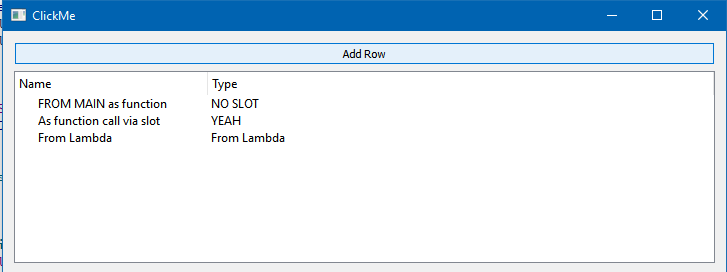
-
@mrjj ok, I am trying to create a custom Graphic Engine (like Unreal 4), at this moment I have a big structure to use all the OpenGL functionality without the knowledge about it (user interface communicates with the Opengl class).
I have one class that inherits from QOpenGLWidget & QOpenglFunctions.
The real problem is that I have to insert rows AFTER the app.exec() call, that means if the user wants to create a simple cube and drag it to the "scene"(the render widget), it has to appear in the QTreeWidget. That is my problem, I don't want the functionality inside this button CreateCube, I want, for example: If the user clicks on the CreateCube button,inside the class QOpenglFunction that I have, create a simple function that receives a simple insertRow(void userdata)*.
That seems impossible, the function won't work. And I repeat, I don't pause the updates with an infinite loop.At this moment of the discussion, I have a TreeNodesManager.ui with the correspondent .h that has the function InsertRow(void* UserData), and inside the ui file I have the QTreeWidget pointer.
In the other side I have my InterfaceRender.h that inherits from QOpenglWidget & OpenGL and if I want to test something: I override the PaintGL() function and put thisclass InterfaceRender : public QOpenglFunctions, public QOpenglWidget { public: //THE CLASS IS NOT COMPLETE void PainGL()override { //And here insert one row per frame (only to test my case) with my own data PointerTo TreeNodesManager->insertRow(&cubeWithParallaxMapping); } }And here my class that manages the QTreeWidget, keep in mind that the QTreeWidget is in the UI file:
class TreeNodesManager : public QWidget {
public:

 TreeNodesManager(QWidget* parent), QWidget(parent) {
    ui->setupUi(this);
    ui->treeWidget->setColumnCount(2);
    ui->treeWidget->setHeaderLabels(QStringList() << "Name" << "Type");

  }
  //And the fantastic function
  void InsertRow(void* UserData) {
    //Cast the user data to anything, I don't care
    QAbstractItemModel* const mdl= ui->treeWidget->model();
     const int rowCount =mdl->rowCount();
     if(mdl->insertRow(rowCount)){
        qDebug("Row Inserted!");
        if(mdl->setData(mdl->index(rowCount,0), UserData->name))
           qDebug("name Written");
        if(mdl->setData(mdl->index(rowCount,1),UserData->description))
           qDebug("description Written");
     }
  }
}
Look the last function insertData, ALL THE qDEBUG is called.
Please explain me how can I insert data AFTER the app.exec() is called (at runtime). I try this in the PainGL() function that is called one time per frame and it doesn't work -
@mrjj ok, I am trying to create a custom Graphic Engine (like Unreal 4), at this moment I have a big structure to use all the OpenGL functionality without the knowledge about it (user interface communicates with the Opengl class).
I have one class that inherits from QOpenGLWidget & QOpenglFunctions.
The real problem is that I have to insert rows AFTER the app.exec() call, that means if the user wants to create a simple cube and drag it to the "scene"(the render widget), it has to appear in the QTreeWidget. That is my problem, I don't want the functionality inside this button CreateCube, I want, for example: If the user clicks on the CreateCube button,inside the class QOpenglFunction that I have, create a simple function that receives a simple insertRow(void userdata)*.
That seems impossible, the function won't work. And I repeat, I don't pause the updates with an infinite loop.At this moment of the discussion, I have a TreeNodesManager.ui with the correspondent .h that has the function InsertRow(void* UserData), and inside the ui file I have the QTreeWidget pointer.
In the other side I have my InterfaceRender.h that inherits from QOpenglWidget & OpenGL and if I want to test something: I override the PaintGL() function and put thisclass InterfaceRender : public QOpenglFunctions, public QOpenglWidget { public: //THE CLASS IS NOT COMPLETE void PainGL()override { //And here insert one row per frame (only to test my case) with my own data PointerTo TreeNodesManager->insertRow(&cubeWithParallaxMapping); } }And here my class that manages the QTreeWidget, keep in mind that the QTreeWidget is in the UI file:
class TreeNodesManager : public QWidget {
public:

 TreeNodesManager(QWidget* parent), QWidget(parent) {
    ui->setupUi(this);
    ui->treeWidget->setColumnCount(2);
    ui->treeWidget->setHeaderLabels(QStringList() << "Name" << "Type");

  }
  //And the fantastic function
  void InsertRow(void* UserData) {
    //Cast the user data to anything, I don't care
    QAbstractItemModel* const mdl= ui->treeWidget->model();
     const int rowCount =mdl->rowCount();
     if(mdl->insertRow(rowCount)){
        qDebug("Row Inserted!");
        if(mdl->setData(mdl->index(rowCount,0), UserData->name))
           qDebug("name Written");
        if(mdl->setData(mdl->index(rowCount,1),UserData->description))
           qDebug("description Written");
     }
  }
}
Look the last function insertData, ALL THE qDEBUG is called.
Please explain me how can I insert data AFTER the app.exec() is called (at runtime). I try this in the PainGL() function that is called one time per frame and it doesn't work@ZiketCPP
One question. this is single threaded correct? None of it runs in other thread?
All part of UI ? Its forbidden to alter UI stuff from other treads unless using signals and slots.Also when you say AFTER the app.exec(), we agree it just means
when app is running ?Why cant u just emit signal from PaintGL() ?
Why must it be function call?But unless there are multiple threads involved, calling the function directly should do it.
since InterfaceRender is also a widget, if u add Q_OBJECT it can emit signals.
¨so
class InterfaceRender : public QOpenglFunctions, public QOpenglWidget {
Q_OBJECT
public:
void PainGL()override {
  //And here insert one row per frame (only to test my case) with my own data
  emit insertRow(&cubeWithParallaxMapping);
}
just define it as a signals in .h
and in
class TreeNodesManager : public QWidget {
Q_OBJECT
public slots:
  void InsertRow(void* UserData)   {...]
then connect them and it should work.
connect(InterfaceRender, SIGNAL(InsertRow(void* )),TreeNodesManagerPTR, SLOT(InsertRow(void* )), Qt::QueuedConnection );Note there might be issue with the cubeWithParallaxMapping since its a void * as QueuedConnection
wants to be able to copy it -
@mrjj my program is single threaded, yes, and the problem is not the Q_OBJECT, that was already added.
I try to emit a signal from PaintGL() and it still doesn't work, is amazing but the insertRow function is called if I emit a signal, but the QTreeWidget is not updated with the row!!!!! That was my problem at the start of the thread.
Why cannot I use the insertRow without signals and slots?
If you have a Pointer to the QTreeWidget in the InterfaceRender class this still doesn't work:class InterfaceRender : public QOpenglFunctions, public QOpenglWidget { Q_OBJECT public: //The pointer to the TreeWidget QTreeWidget* TreePointer; //The update function void PainGL()override { //And here insert one row per frame (only to test my case) with my own data //Cast the user data to anything, I don't care QAbstractItemModel* const mdl= TreePointer->model(); const int rowCount =mdl->rowCount(); if(mdl->insertRow(rowCount)){ qDebug("Row Inserted!"); if(mdl->setData(mdl->index(rowCount,0), UserData->name)) qDebug("name Written"); if(mdl->setData(mdl->index(rowCount,1),UserData->description)) qDebug("description Written"); } } }Explain me, why I can't use this? Imagine that the pointer exists (is set at any point of the program). If you try something like this, the QTreeWidget won't show ANYTHING, it seems that is empty... That was the main problem.
-
@mrjj my program is single threaded, yes, and the problem is not the Q_OBJECT, that was already added.
I try to emit a signal from PaintGL() and it still doesn't work, is amazing but the insertRow function is called if I emit a signal, but the QTreeWidget is not updated with the row!!!!! That was my problem at the start of the thread.
Why cannot I use the insertRow without signals and slots?
If you have a Pointer to the QTreeWidget in the InterfaceRender class this still doesn't work:class InterfaceRender : public QOpenglFunctions, public QOpenglWidget { Q_OBJECT public: //The pointer to the TreeWidget QTreeWidget* TreePointer; //The update function void PainGL()override { //And here insert one row per frame (only to test my case) with my own data //Cast the user data to anything, I don't care QAbstractItemModel* const mdl= TreePointer->model(); const int rowCount =mdl->rowCount(); if(mdl->insertRow(rowCount)){ qDebug("Row Inserted!"); if(mdl->setData(mdl->index(rowCount,0), UserData->name)) qDebug("name Written"); if(mdl->setData(mdl->index(rowCount,1),UserData->description)) qDebug("description Written"); } } }Explain me, why I can't use this? Imagine that the pointer exists (is set at any point of the program). If you try something like this, the QTreeWidget won't show ANYTHING, it seems that is empty... That was the main problem.
@ZiketCPP
Ok and you are 1000% sure TreePointer points to the UI one ?I cant explain it. seems not right. Also if it triggers the signal and goes into the
insertRow function then unless its wrong model or wrong Tree, it should
work.
Have you tried add a line in Designer and check if the Tree you talk to have 1 item? -
@mrjj thanks to you I found the problem,
The QWidget paint was not complete, in my QTreeWidget, that was cause errors displaying the content, it only displays the content inserted via Constructor, all after this won't be shown. I was playing with the bad framebuffer....
Sorry about this, and really thank you!
How can I mark this thread as Solved? -
@mrjj thanks to you I found the problem,
The QWidget paint was not complete, in my QTreeWidget, that was cause errors displaying the content, it only displays the content inserted via Constructor, all after this won't be shown. I was playing with the bad framebuffer....
Sorry about this, and really thank you!
How can I mark this thread as Solved?
